
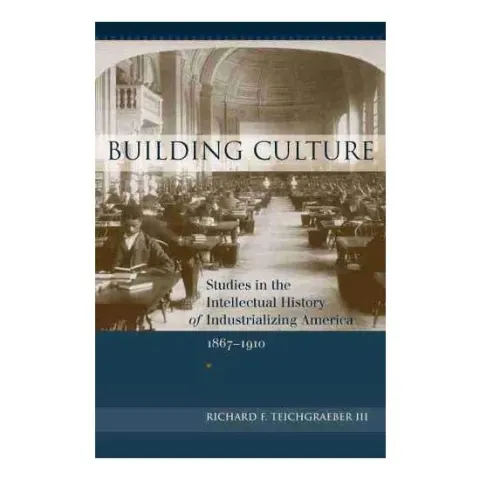
 Building culture
Prețuri actualizate de 4 ori pe zi. Bookuria primește un mic comision dacă cumperi după un click, fără cost în plus pentru tine.
Istoricul prețului
cel mai mic preț din toate librăriile, zi de zi, din 20 octombrieAcum e cel mai mic preț de când îl urmărim (din 20 octombrie).
- Azi
- 8,99 lei
- Cel mai mic
- 8,99 lei29 octombrie
- Media
- 13,49 lei
- Cel mai mare
- 13,99 lei
Anunță-mă când se ieftineșteÎți scriem când prețul scade sub 8,99 lei (cu cel puțin 5%).
Despre carte
An unprecedented wave of interest in building new cultural institutions swept through America from the end of the Civil War through the first decade of the twentieth century. Traditionally historians have told us that this sea change was the work of various elites intent on controlling the turmoil and divisions that accompanied the industrialization of the American economy. In Building Culture, Richard Teichgraeber rejects this hierarchical account to pursue one that highlights the multiplicity of attitudes and interests that were on display in America's first great effort to build national cultural institutions.
Teichgraeber also lays the groundwork of a new interpretive framework for understanding this multisided effort. Most native-born American champions of culture, he contends, viewed it as an authentically individualistic ideal. For them the concept continued to carry its antebellum meaning of self-culture--that is, individual self-development or self-improvement--and thus was quite resistant to closure around any single fixed definition of what being cultivated might mean.
They also recognized that in America culture had to connect with the choices of ordinary men and women and therefore had to be fashioned to serve the uses of a democratic rather than an aristocratic society. To show how and why this inclusive view of culture was accompanied by a prodigious expansion of American cultural institutions, Teichgraeber also explores two of the central but still inadequately mapped developments in the intellectual and cultural history of the industrial era: the multifaceted--and ultimately successful--effort to secure Ralph Waldo Emerson a central place in American culture at large; and the growth and consolidation of the American university system, certainly the most...
Recenzii de la cititori
Toate recenziile →Ai citit cartea? Spune-le și altor cititori cum ți s-a părut. Recenziile se scriu din contul gratuit de cititor.
Încă nicio recenzie de la cititori. Fii primul care scrie una!
Cărți asemănătoare
 Noua Europa. Vol. 2: O istorie politica a (re)unificarii europeneIordan Gheorghe Barbulescu
Noua Europa. Vol. 2: O istorie politica a (re)unificarii europene
Iordan Gheorghe Barbulescu 9,99 lei
 Siria. Țara care ne-a fost casăAlia Malek
Siria. Țara care ne-a fost casă
Alia Malek 5,00 lei
 Dragă Sisiluț, noi pe lumea asta nu o să ne mai vedemAnca Ștef, Raul Ștef
Dragă Sisiluț, noi pe lumea asta nu o să ne mai vedem
Anca Ștef, Raul Ștef 10,00 lei
 Viața de zi cu zi în documente vechi de familieCatalin D. Constantin
Viața de zi cu zi în documente vechi de familie
Catalin D. Constantin 10,00 lei
 Blocați conturile! Crimă și spălare de bani în Rusia lui PutinBill Browder
Blocați conturile! Crimă și spălare de bani în Rusia lui Putin
Bill Browder 10,00 lei
 Despre impuritatea literaturiiAlex. Stefanescu
Despre impuritatea literaturii
Alex. Stefanescu 5,00 lei