
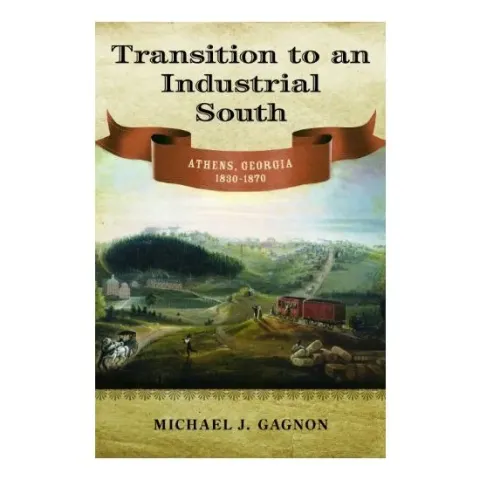
 Transition to an Industrial South
Prețuri actualizate de 4 ori pe zi. Bookuria primește un mic comision dacă cumperi după un click, fără cost în plus pentru tine.
Istoricul prețului
cel mai mic preț din toate librăriile, zi de zi, din 20 octombriePrețul n-a mai fost schimbat de pe 20 octombrie.
- Azi
- 13,99 lei
- Cel mai mic
- 13,99 lei20 octombrie
- Media
- 13,99 lei
- Cel mai mare
- 13,99 lei
Anunță-mă când se ieftineșteÎți scriem când prețul scade sub 13,99 lei (cu cel puțin 5%).
Despre carte
Renowned New South booster Henry Grady proposed industrialization as a basis of economic recovery for the former Confederacy. Born in 1850 in Athens, Georgia, to a family involved in the city's thriving manufacturing industries, Grady saw firsthand the potential of industrialization for the region. In Transition to an Industrial South, Michael J. Gagnon explores the creation of an industrial network in the antebellum South by focusing on the creation and expansion of cotton textile manufacture in Athens.
By 1835, local entrepreneurs had built three cotton factories in Athens, started a bank, and created the Georgia Railroad. Although known best as a college town, Athens became an industrial center for Georgia in the antebellum period and maintained its stature as a factory hub even after competing cities supplanted it in the late nineteenth century. Georgia, too, remained the foremost industrial state in the South until the 1890s.
Gagnon reveals the political nature of procuring manufacturing technology and building cotton mills in the South, and demonstrates the generational maturing of industrial laboring, managerial, and business classes well before the advent of the New South era. He also shows how a southern industrial society grew out of a culture of social and educational reform, economic improvements, and business interests in banking and railroading. Using Athens as a case study, Gagnon suggests that the connected networks of family, business, and financial relations provided a framework for southern industry to profit during the Civil War and served as a principal guide to prosperity in the immediate postbellum years.
Recenzii de la cititori
Toate recenziile →Ai citit cartea? Spune-le și altor cititori cum ți s-a părut. Recenziile se scriu din contul gratuit de cititor.
Încă nicio recenzie de la cititori. Fii primul care scrie una!
Cărți asemănătoare
 Noua Europa. Vol. 2: O istorie politica a (re)unificarii europeneIordan Gheorghe Barbulescu
Noua Europa. Vol. 2: O istorie politica a (re)unificarii europene
Iordan Gheorghe Barbulescu 9,99 lei
 Siria. Țara care ne-a fost casăAlia Malek
Siria. Țara care ne-a fost casă
Alia Malek 5,00 lei
 Dragă Sisiluț, noi pe lumea asta nu o să ne mai vedemAnca Ștef, Raul Ștef
Dragă Sisiluț, noi pe lumea asta nu o să ne mai vedem
Anca Ștef, Raul Ștef 10,00 lei
 Viața de zi cu zi în documente vechi de familieCatalin D. Constantin
Viața de zi cu zi în documente vechi de familie
Catalin D. Constantin 10,00 lei
 Blocați conturile! Crimă și spălare de bani în Rusia lui PutinBill Browder
Blocați conturile! Crimă și spălare de bani în Rusia lui Putin
Bill Browder 10,00 lei
 Despre impuritatea literaturiiAlex. Stefanescu
Despre impuritatea literaturii
Alex. Stefanescu 5,00 lei